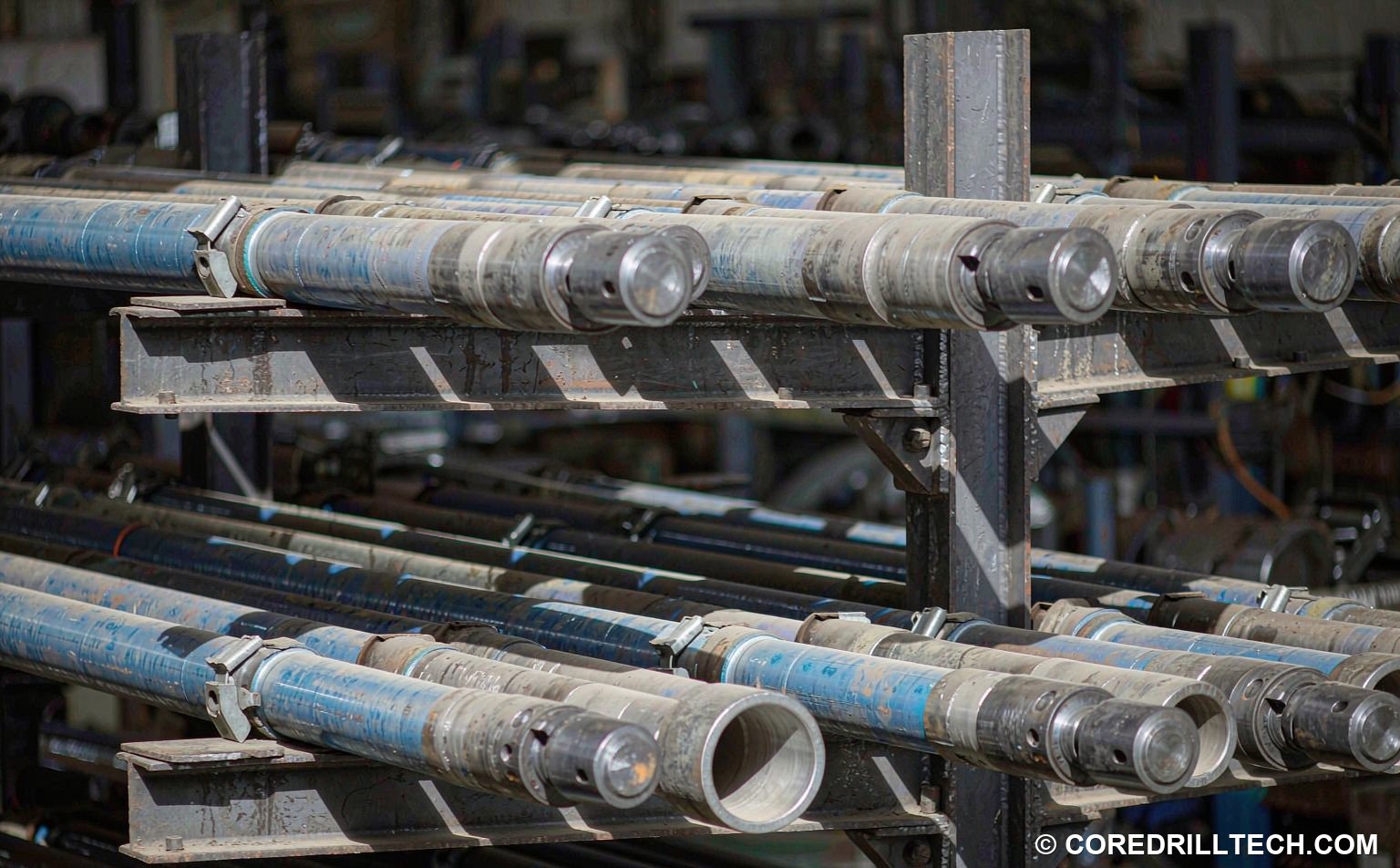
Most contractors quote wireline as the default for depths beyond 150 m, and for good reason: the inner tube is retrieved by overshot on a thin rope, so the rod string stays in the hole. A 300 m hole that needs 40 core runs saves roughly 40 full trips — several shifts of labour.
The saving is not linear. Below about 100 m, conventional double-tube coring with short rods is often faster, because the wireline head assembly and overshot add handling time at every run and the crew has less to gain from not tripping.
Formation matters as much as depth. In broken ground, wireline barrels recover poorly unless the core lifter and inner tube are matched to the rock; the cost saved on tripping is lost to low recovery and re-drilling.
A practical rule from our own field data: if the hole is deeper than 150 m, the rock is competent enough for 90%+ recovery, and the crew is trained on overshot handling, wireline wins on cost per metre. If any of those three is missing, fix it before buying the barrel.
One more variable is often ignored — rod quality. Wireline rods see more make-and-break cycles per metre than conventional rods, so thread hardening and dimensional consistency are what actually keep the cost advantage.